14 Small Kids’ Room Storage Ideas (Toy Rotation by Age, No Drilling)
Kids room storage ideas for small rooms start with one fact: a small kids’ room does not have a toy problem, it has a too-many-toys-out-at-once problem — the floor fills up because every toy is visible, reachable and in the way at the same time. The fix is not a bigger room or a bigger toy box: it is fewer toys out, each one in a bin a child can actually reach, and the rest resting out of sight until their turn comes round — in rolling bins under the bed or on a closet shelf, which is where the rotated toys live in a small flat. The numbers are small on purpose: roughly 3–6 toys out for babies, 6–10 for toddlers swapped every 1–2 weeks, and 8–12 for preschoolers every 2–3 weeks. Every idea below is sorted by age, because a toddler needs open bins at floor level and a ten-year-old needs drawers for small pieces — and every idea stands on the floor, leans, rolls or sticks on with adhesive, nothing drilled into a wall you do not own. Most ideas cost nothing or under $25, and the most important one is free: sort the toys first, buy the storage second — a bin system bought before the sort just gives the clutter a nicer box to hide in.
Before you buy anything — 3 rules
- Store by reach, not by looks. A toy a child cannot reach is a toy a parent puts away. As a working guide: floor to about 24 in is toddler reach (open bins, current favourites, board books); 24 to 40 in is preschool to early-elementary reach (labelled bins, cubbies, the toys they clean up themselves); 40 to 54 in is older kids (drawers, books, projects); above 54 in is adults only (rotation box, outgrown toys, anything with small parts for younger siblings). Anything the child is expected to put away belongs in the zone they can reach without climbing. Source: Closet World
- Rotate first — the numbers are small. In a 2018 University of Toledo study (Dauch et al., Infant Behavior and Development), 36 toddlers aged 18 to 30 months played longer with each toy, and in more varied ways, when they had 4 toys than when they had 16. Use that as the direction, not a strict count: roughly 3–6 toys out for babies, 6–10 for toddlers swapped every 1–2 weeks, 8–12 for preschoolers every 2–3 weeks, and by theme or monthly for school-age children. One balanced set out, the rest in 3–4 labelled bins stored out of sight — closet shelf, under the bed, or a high shelf. Sources: ToyHobbyist ; Storilu ; University of Toledo
- Anchor anything tall, and keep small parts up high. The US CPSC’s Anchor It! guidance is blunt: any piece of furniture that could topple if a child plays near it, bumps it or climbs on it should be anchored to the wall — and nearly 80% of furniture, TV and appliance tip-over deaths involve children aged 5 and younger. Tall bookcases and shelf units in a kids’ room must be anchored; each strap leaves one small screw hole, so this is a landlord conversation worth having first, not a reason to skip it. Separately, keep small parts away from children under 3: the CPSC small-parts tester is a cylinder 2.25 in long by 1.25 in wide, about the size of a 3-year-old’s throat — at home a toilet-paper tube is the rough stand-in, and if a toy or a loose piece fits inside it, it is too small for a young child. Sources: CPSC ; CPSC OnSafety
How many toys out, by age
| Age | Toys out at once | Rotate | Storage that works |
|---|---|---|---|
| Under 3 | 3–6 | Every few days to weekly | A few open bins at floor level, one type per bin; low shelf, books facing out |
| 3 to 5 | 8–12 | Every 2–3 weeks | Picture-labelled bins, cubbies at eye level, low table with storage underneath |
| 5 to 8 | By theme, 8–12 | Monthly or when interest drops | Shallow drawers / divided trays for small pieces, a shelf for a project in progress |
| 8 to 12 | Child helps choose | Monthly, child-led | Drawers, a desk surface, hooks for gear, shelves that convert to books and display |
1. Do the toy audit before you buy a single bin
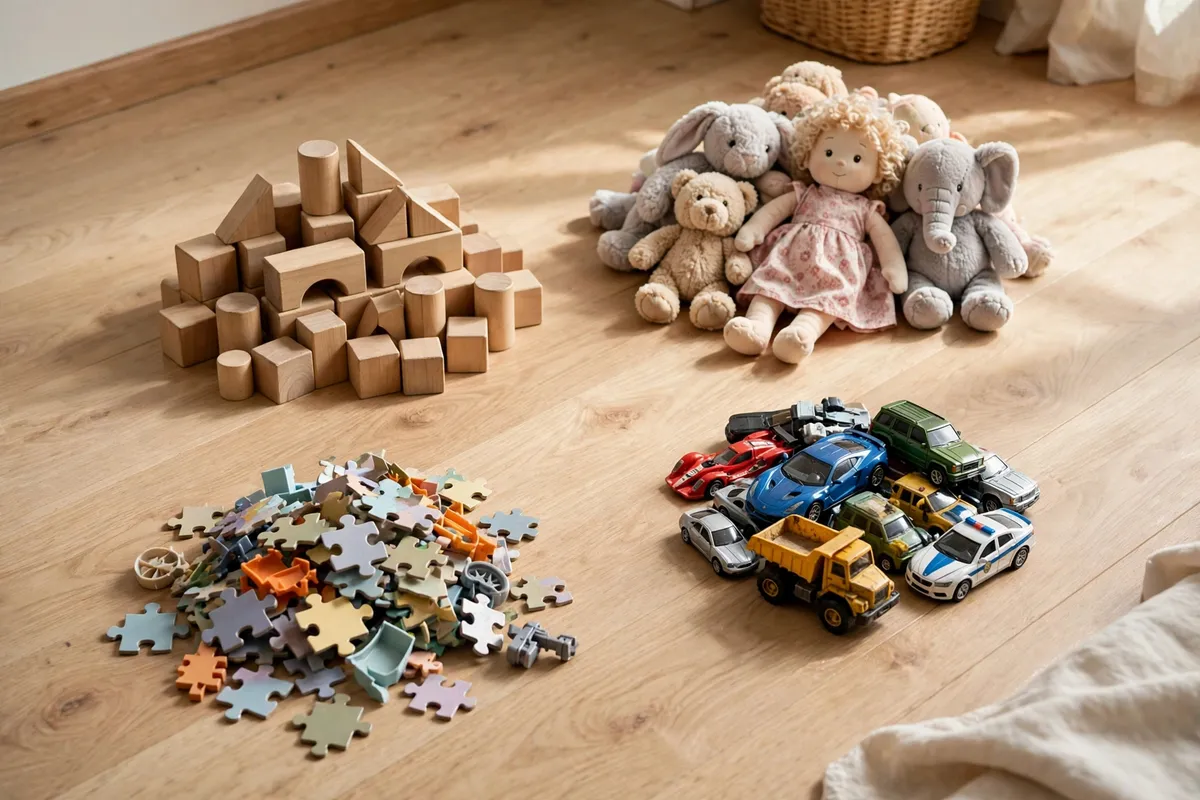
This is the idea everything else hangs on, and it costs nothing. Take every toy out of the room — bedroom, living room, car, grandparents’ drop-offs — and sort into four piles: keep and use often, keep but rotate, donate, toss (broken pieces, missing-parts puzzles, fast-food toys). Aim to cut total toy volume by at least a third; fewer toys means smaller storage furniture, which is exactly what a small room needs.
Try this: do the gather while your child is asleep or out, unless you enjoy negotiating over every single item. Put back only 6–10 things for a toddler, chosen for the play patterns they use right now — not for what they might grow into.
Cost: free · Time: 20–30 minutes · Renter-safe: yes.
2. Put out one balanced set — one toy from each kind of play
A rotation works because the set is balanced, not because it is small. Sort the keepers by play type — building, pretend, puzzles and problem-solving, art, books, movement, small world — and put out roughly one item from each category, plus a couple of daily favourites that stay out permanently. A four-year-old with twelve toys across six categories plays longer than a four-year-old with twelve toys that are all vehicles. The same balanced set works in the living room too, if that is where play happens most days.
Try this: build 3–4 balanced bins for the resting toys, one item from each category in each bin, and number them so you know which one comes next. When a bin comes back out after two or three weeks away, it feels new again.
Cost: free (use bins you already have) · Time: 20 minutes to sort · Renter-safe: yes.
3. Use a low open shelf with books facing out
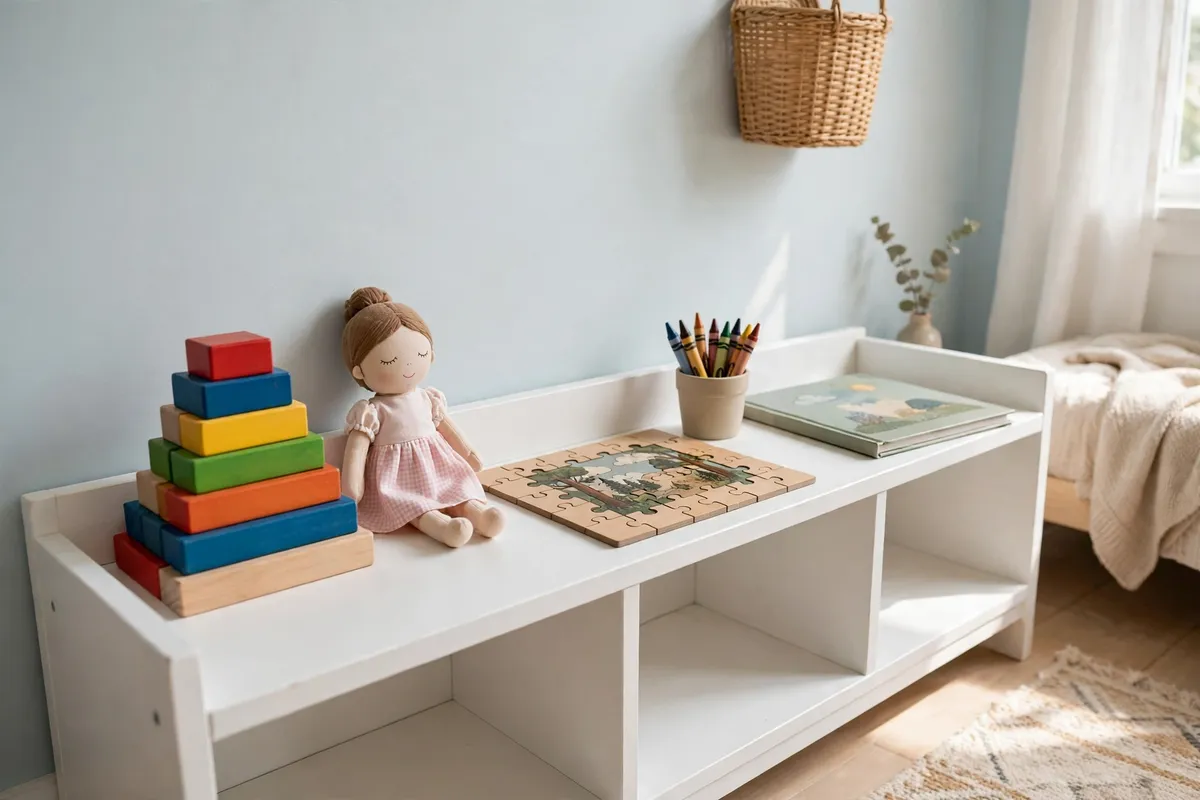
Deep toy boxes hide toys; low open shelves show them. A shelf at toddler height with books facing out — covers visible, not spines — lets a child choose without pulling everything down, and a few toys on the shelf, not a pile, keeps cleanup to one shelf, not the whole room. Keep the bottom shelf within a toddler’s reach for independent cleanup, and reserve higher shelves for toys with small parts. This is the Montessori approach in practice: everything at the child’s height, everything visible, everything reachable.
Try this: put out 3–6 books facing out and swap them with the rotation, the same week you swap the toys. If a book has not been picked up in two rotations, it goes into the resting bin.
Cost: $0–$40 for a low shelf or picture ledges · Time: 20 minutes · Renter-safe: yes, freestanding or leaning — a tall shelf must be anchored (see rule 3 above).
4. Let a TROFAST step frame do the heavy lifting
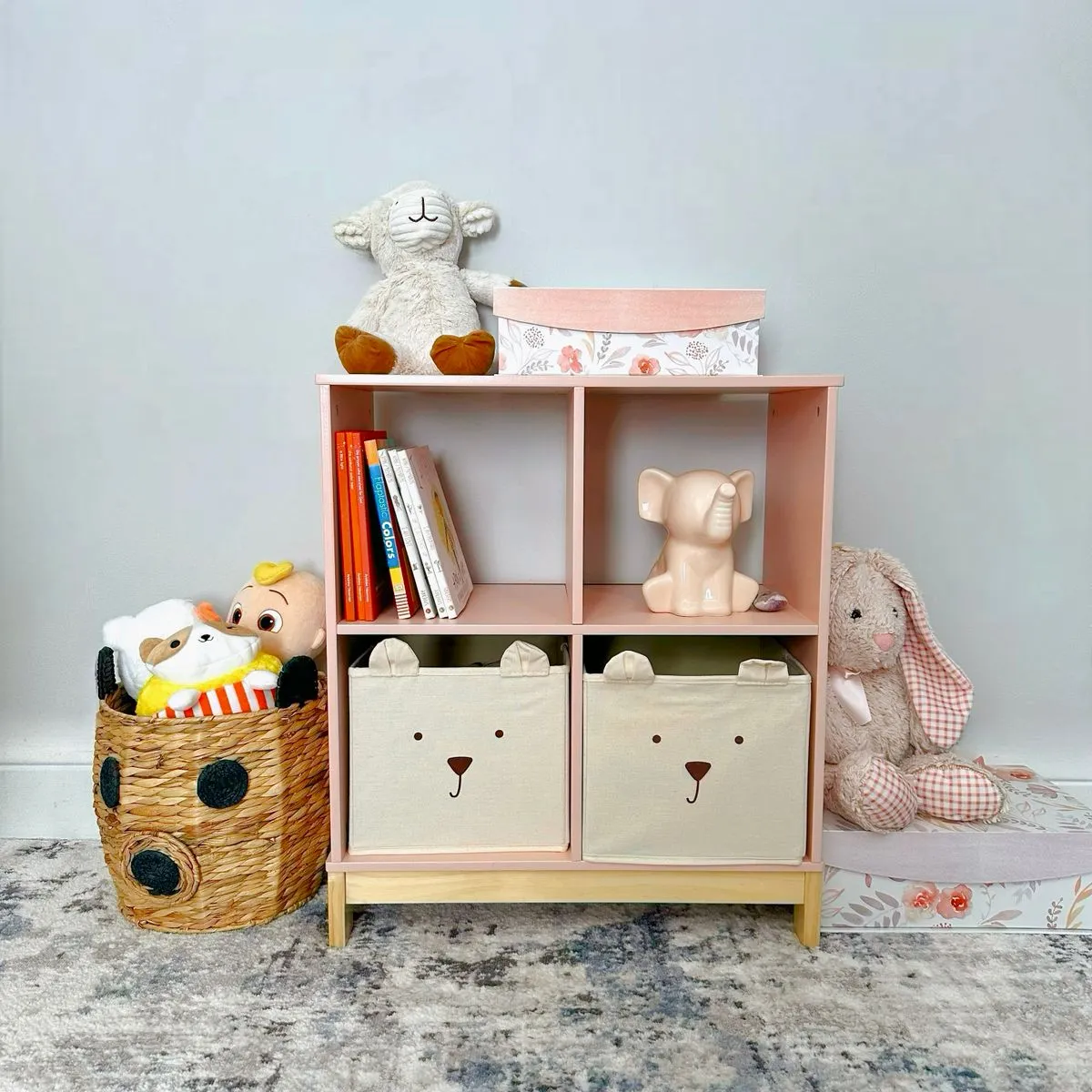
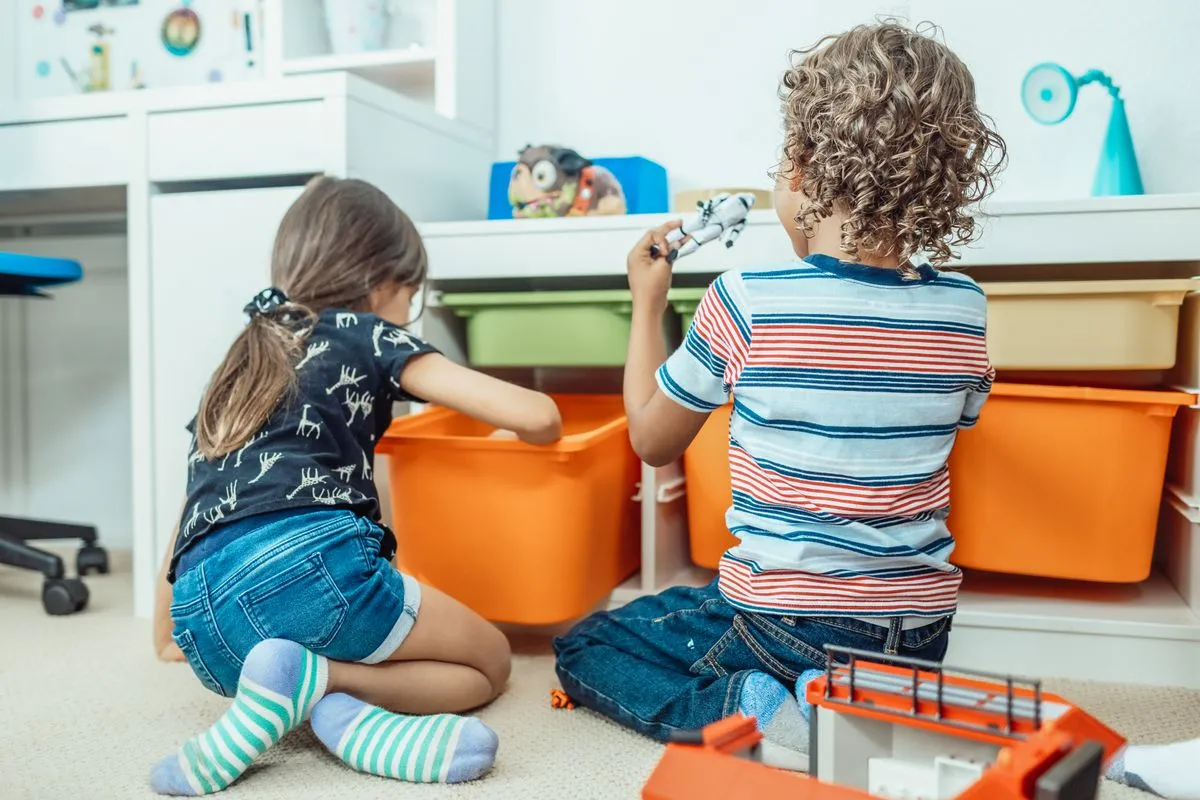
The IKEA TROFAST is the standard kids’-room unit for a reason: a stepped frame with grooved tracks that hold slide-out plastic bins, so a toddler can reach the bottom bins while the top tier holds the things that need an adult — markers, small parts, the project in progress. The common frame is about 99 x 44 x 94 cm (36 5/8 x 17 3/8 x 35 7/8 in) with 42 x 30 x 23 cm boxes, and IKEA sells a version that doubles as a room divider for shared rooms, accessible from both sides. Turn the low frame sideways with a baseplate on top and it becomes a LEGO table, so the same unit is a building station as well as storage. Source: IKEA
Try this: one bin, one kind of toy — blocks in one, vehicles in another, dress-up in a third. Mixed-category bins are where pieces get lost and cleanup stalls; a child who can see the category can put it back without being told twice.
Cost: about $95–$170 for a TROFAST combination · Time: 30–60 minutes to assemble · Renter-safe: freestanding; anchor it — it is tall, and kids climb it.
5. Lay a KALLAX on its side as a reading bench
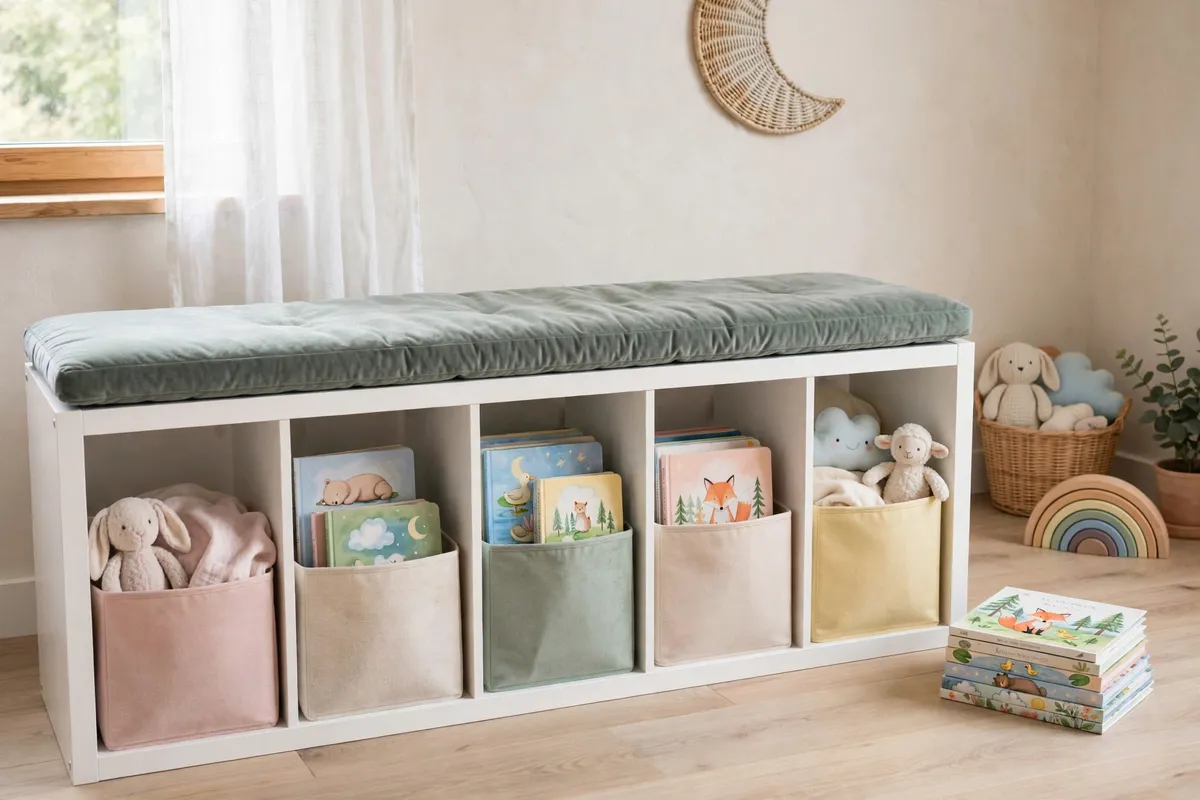
A 2×4 KALLAX laid on its long side becomes a 57 5/8 in wide bench about 30 1/8 in tall, with eight cubbies a toddler can pull board books and soft bins from without climbing — add a foam cushion and the flat top is a reading perch. The 2×2 unit is 77 x 39 x 77 cm (about 30 1/8 x 15 3/8 x 30 3/8 in), takes DRÖNA fabric boxes at 13 x 15 x 13 in, and each shelf holds about 29 lb. Swap the inserts as the child grows: soft bins for a toddler, two-drawer inserts for LEGO and tiny craft supplies for a school-age child. Source: Little Nook Home
Try this: assign each horizontal row a job — bottom row for the current rotation, middle row for books, top row for the project in progress. When the child outgrows a row, change the insert, not the unit.
Cost: about $80 for a 2×4 KALLAX, $5 per DRÖNA box · Time: 30 minutes to assemble · Renter-safe: freestanding on its side; anchor the upright 3×3 version.
6. Label every bin with a picture, not just a word
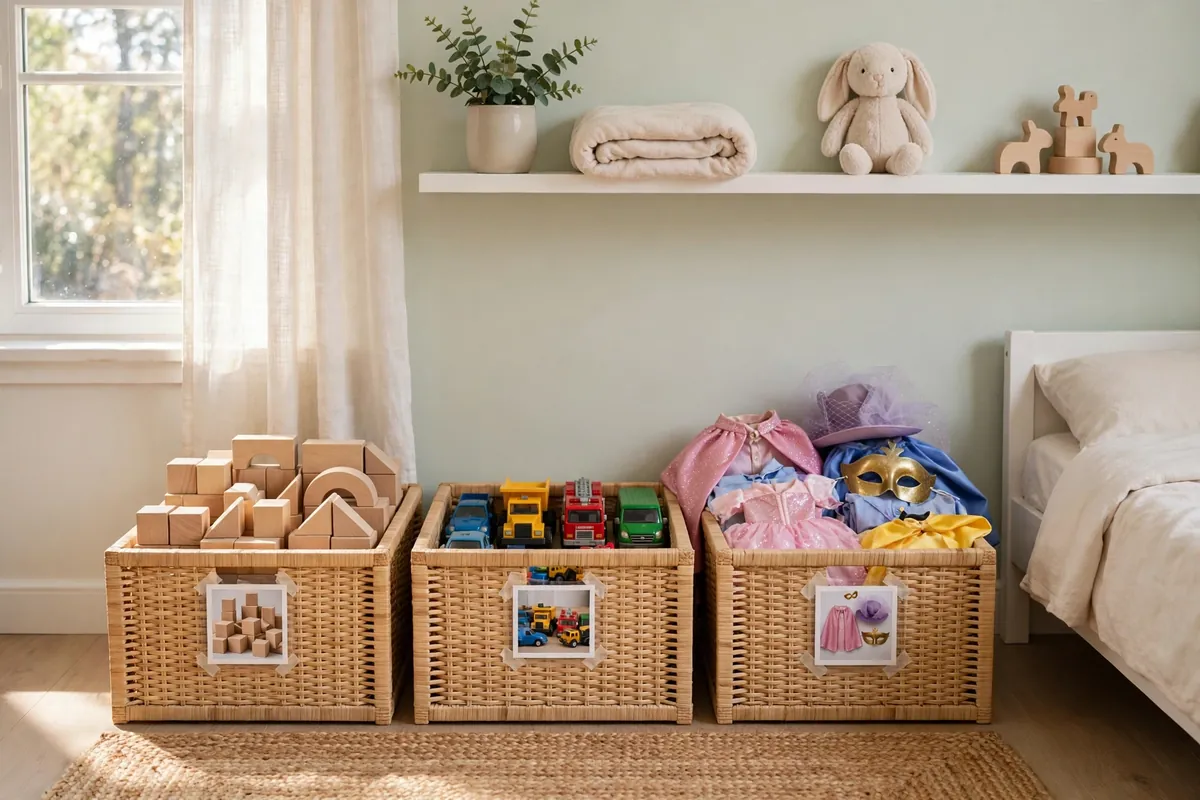
A toddler cannot read “blocks”, but they can read a photo of blocks. Picture labels — a photo or a simple drawing taped to the front of each bin — are what make cleanup something a child can do alone, and they are the difference between labelled bins and bins that stay labelled for a week. For preschoolers, add the word under the picture; for older kids, add a number that matches the rotation bin.
Try this: photograph the actual contents of each bin, print the photo small, and tape it on. When the contents change at the next rotation, swap the photo — a label that lies about what is inside is worse than no label.
Cost: free (phone photos + tape) · Time: 15 minutes · Renter-safe: yes.
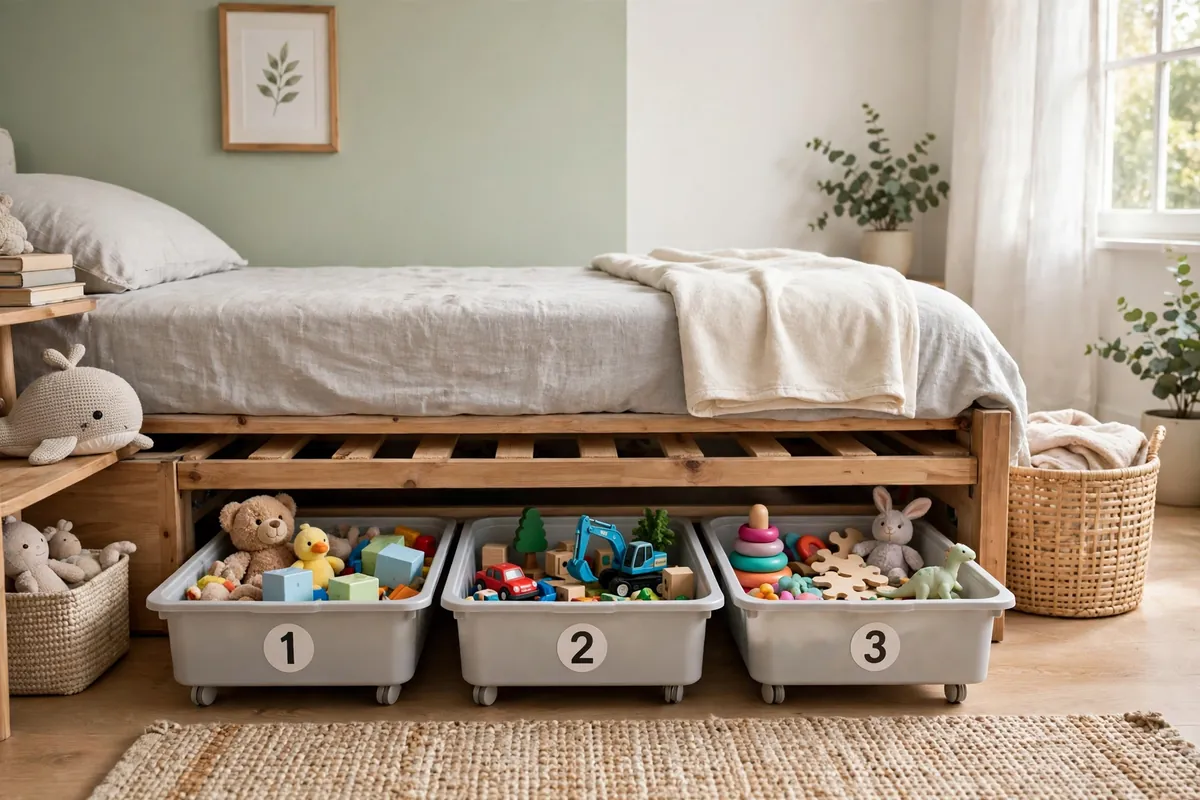
7. Put the resting toys under the bed in rolling bins
The rotation box has to live somewhere, and under the bed is the dead space a small room already has. Shallow rolling bins slide out for a swap and slide back out of sight — one bin per rotation set, numbered to match the picture labels. Keep the heavy things low and the resting toys out of the child’s reach, so “resting” actually means resting, not “hidden in plain sight”.
Try this: label the under-bed bins 1, 2, 3 and swap in order, every 1–2 weeks for a toddler, every 2–3 weeks for a preschooler. If a toy comes back out and is ignored again, it goes in the donate pile, not back under the bed.
Cost: $15–$40 for shallow rolling bins · Time: 10 minutes · Renter-safe: yes.
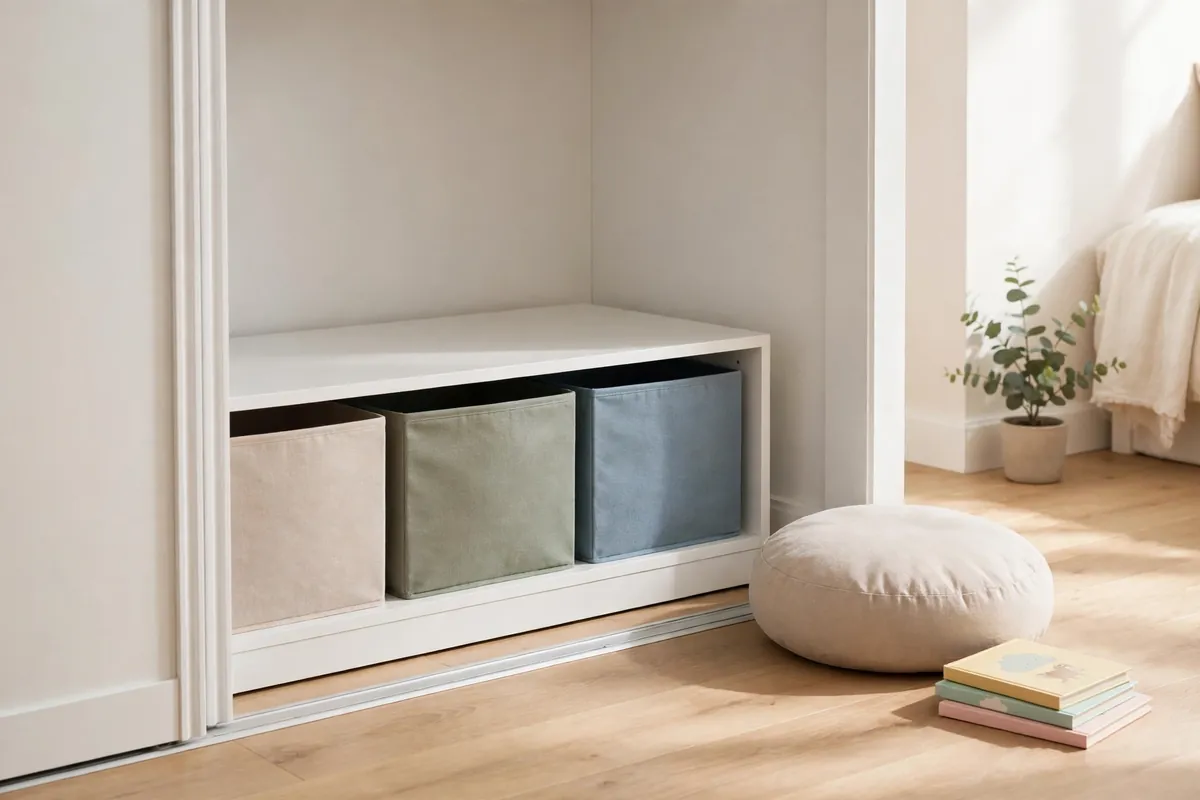
8. Turn the closet into the toy closet — doors off, shelves low
A reach-in closet is about 24 in deep, which is roughly the depth of a low shelf already. Lift the sliding doors off their track, put a low KALLAX or a TROFAST frame at one end and a plush floor cushion beside it, and the closet becomes the play zone — with the resting bins on the closet shelf above, out of reach. Bag the hinges and screws, label the bag and tape it inside the closet, so move-out day is ten minutes, not an hour of hunting.
Try this: measure the closet depth first and confirm the 15 3/8 in KALLAX frame sits clear of the doorframe trim before you buy it. If the closet is shared, give each child one end and keep the shared toys in the middle.
Cost: $0 for the closet itself; $80–$170 for the unit inside · Time: an afternoon · Renter-safe: yes — keep the doors safe, do not cut or paint the closet.
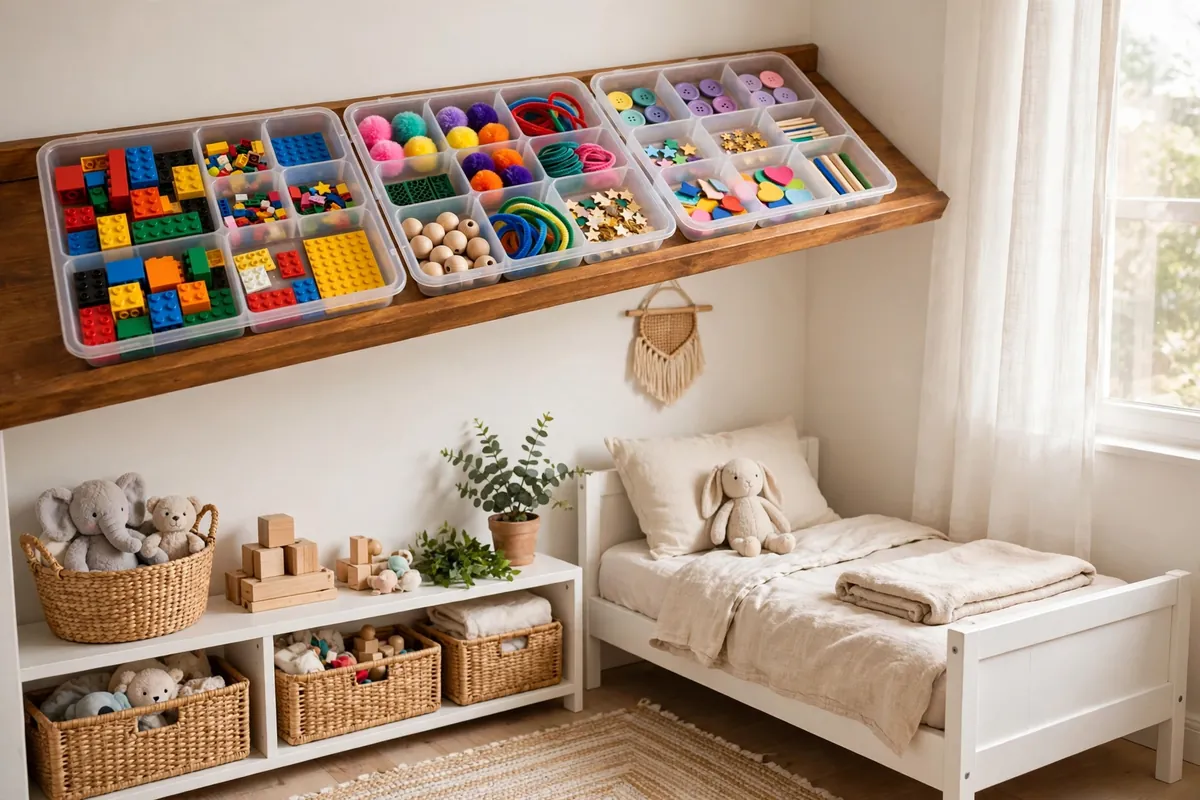
9. Give small pieces a high, divided home — and run the tube test
LEGO, craft supplies and board-game pieces are the toys that defeat open bins: deep cubbies swallow small pieces whole, and a stray brick on the floor at night teaches the lesson fast. Give them shallow drawers or divided trays — two-drawer KALLAX inserts are 13 by 13 in and open with one finger — on a shelf above toddler reach, and keep the current building project out on its own tray overnight. Before anything small goes into a room with a child under 3, run the toilet-paper tube test: if the toy or a loose piece fits inside the tube, it is too small for that child.
Try this: keep one tray per project, not one tray per colour. A project tray a child can carry to the table and back is a project that gets finished; a box of mixed pieces is a box that gets tipped out.
Cost: $25 per two-drawer insert; $10–$20 for divided trays · Time: 10 minutes · Renter-safe: yes.
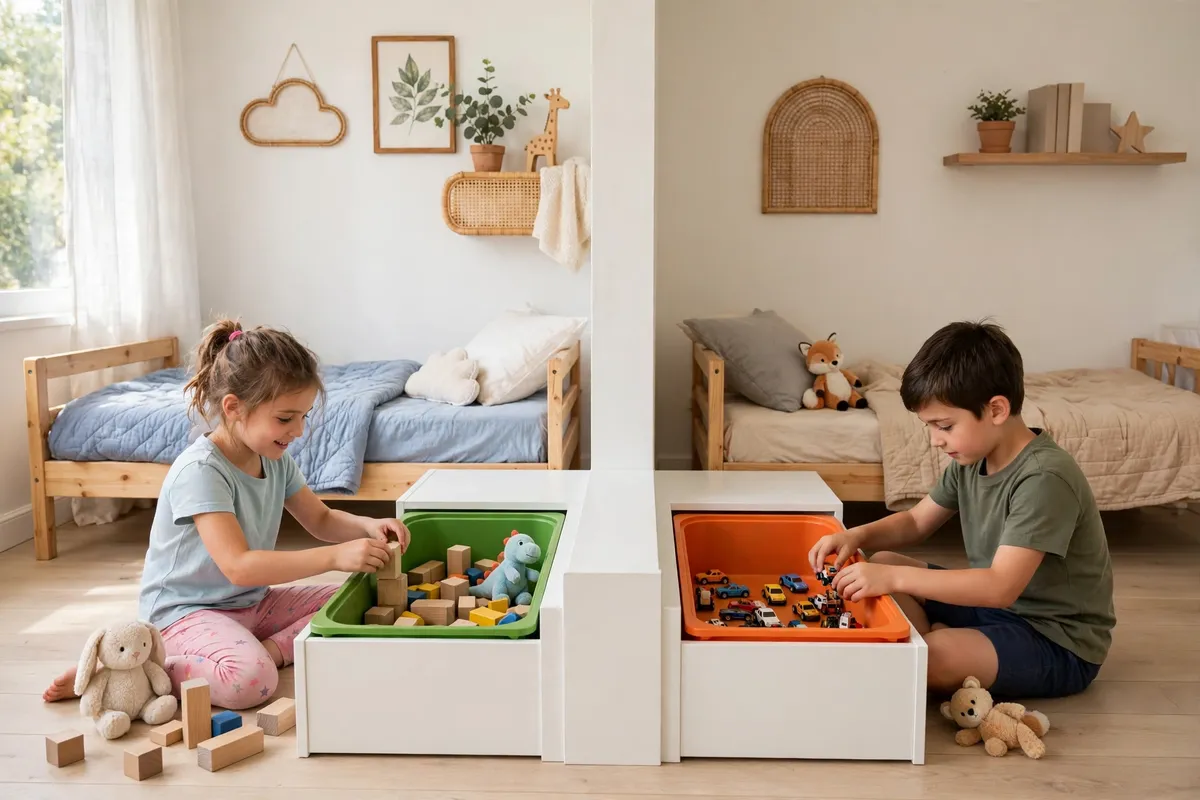
10. Share the room by giving each child one bin and one shelf
Shared bedrooms fail when everything is shared and nothing is anyone’s. Assign each child a labelled under-bed bin and a top shelf for personal items, keep the shared toys in the main zone, and let the TROFAST room-divider version split the room so both sides can reach it. One bin per child, one shared zone — the rule is simple enough for a five-year-old to enforce.
Try this: let each child pick the colour of their own bin and the photo on its label. Ownership is what makes a child put their own things away; a bin in someone else’s colour is just another box.
Cost: $0–$30 for an extra bin and labels · Time: 15 minutes · Renter-safe: yes.
11. Roll the art and homework away on a cart
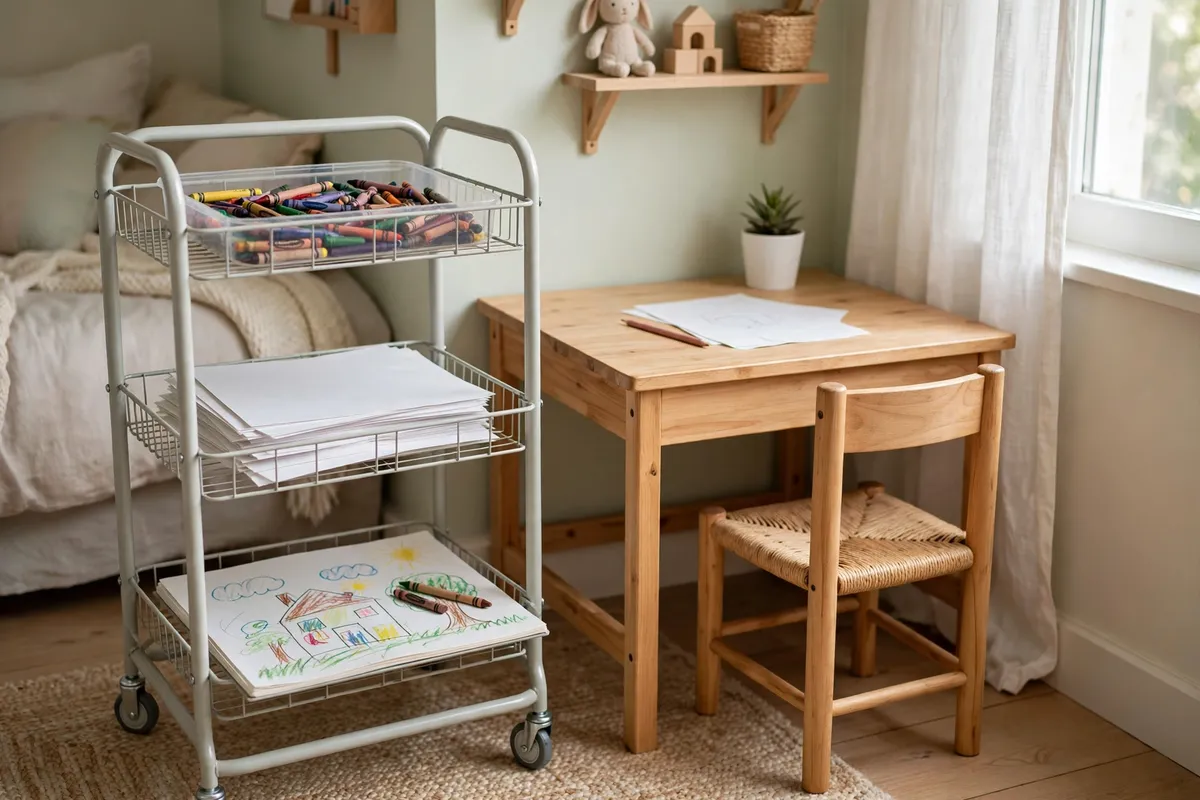
Art supplies and homework are the toys that spread furthest, because they need a table and then stay on it. A small three-tier rolling cart — the IKEA RÅSKOG is 11 by 15 by 24 in and about $30 — parks beside the bed or in the closet, holds crayons and paper on top, the current project in the middle, and a slim file box at the bottom, and rolls to the table when it is time to make something. When the project is done, the cart rolls back and the table is a table again.
Try this: pack the cart the same way every time — top tier for what is used daily, middle for the project in progress, bottom for the heavy box. If it takes more than two minutes to pack, something in the cart does not earn its place.
Cost: about $30 for the cart · Time: 0 minutes to set up · Renter-safe: yes, freestanding on wheels.
12. Keep one “out” box by the door — donate, swap, repeat
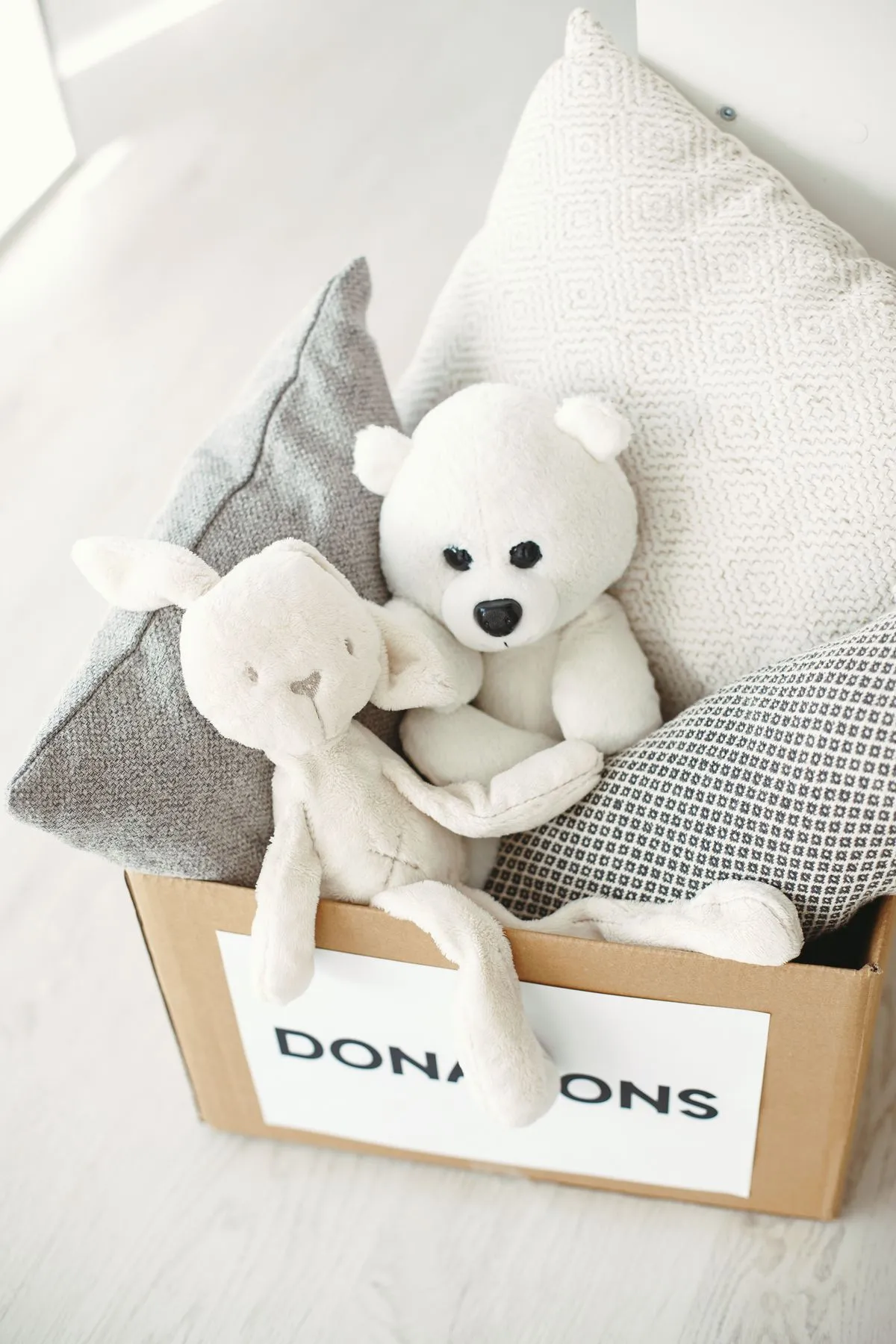
The last idea is the one that stops the room filling up again: a single box by the door for outgrown and ignored toys, added to at every rotation. When it is full, it leaves the house — donate, pass on, or swap with another family — and the space it frees is the space the next rotation needs. No second toy box, no “maybe later” pile in the closet: one box, one rule, out when full.
Try this: at every rotation, ask one question per toy that was ignored twice: would another child play with this? If yes, it goes in the out box today, not at the next clean-out.
Cost: free (one box you already have) · Time: 5 minutes per rotation · Renter-safe: yes.
13. Give the stuffed animals a hammock, not a pile
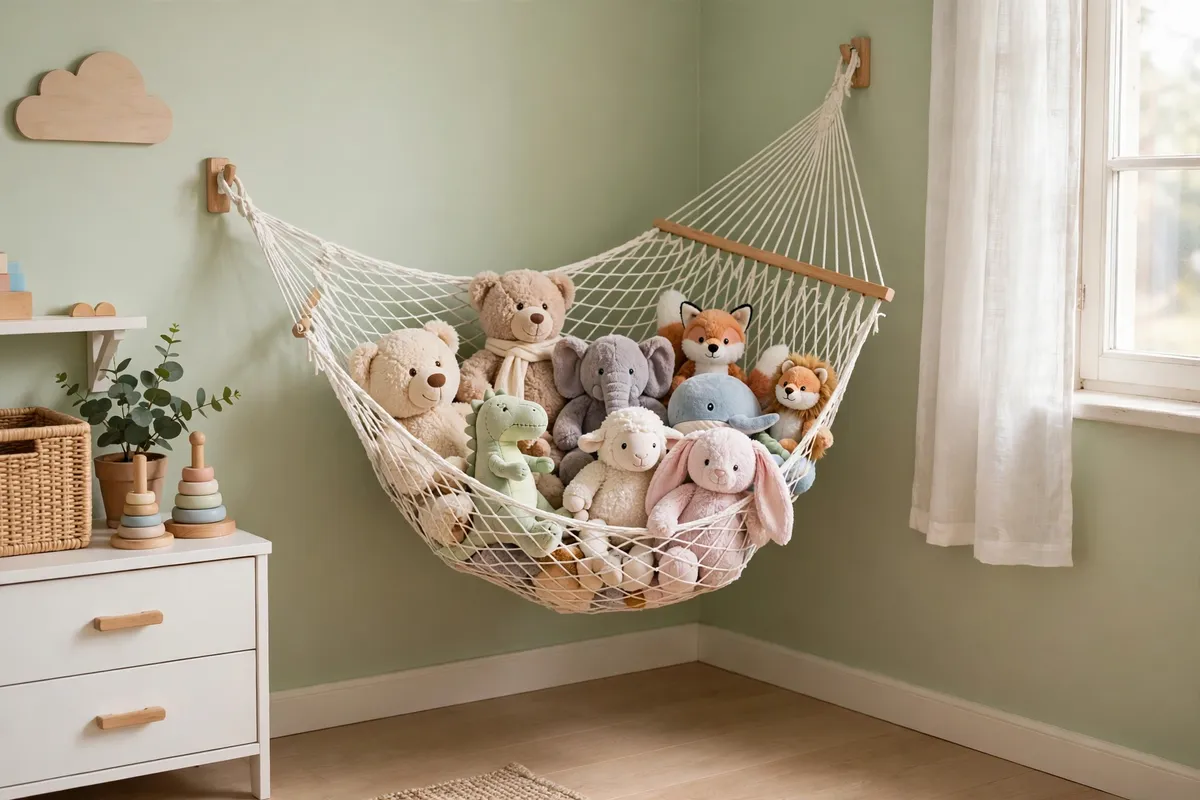
Stuffed animals are the toys that defeat every bin, because they are light, bulky and never stack. A toy hammock strung across a corner holds dozens of soft toys off the floor and off the bed, and a child can see and reach them — or a stuffie bean bag chair swallows the pile and becomes a seat, which is the version that works when there is no free corner. Both cost about $10–$15, both need no drilling (the hammock hangs from adhesive hooks or a tension rod), and both turn the plush pile into something the room can hold.
Try this: put the hammock at the child’s eye level, not the ceiling — if they cannot reach a toy to play with it, it is decoration, not storage. When the hammock is full, that is the signal: one soft toy in, one out to the “out” box.
Cost: about $10–$15 · Time: 10 minutes · Renter-safe: yes, adhesive hooks or tension rod.
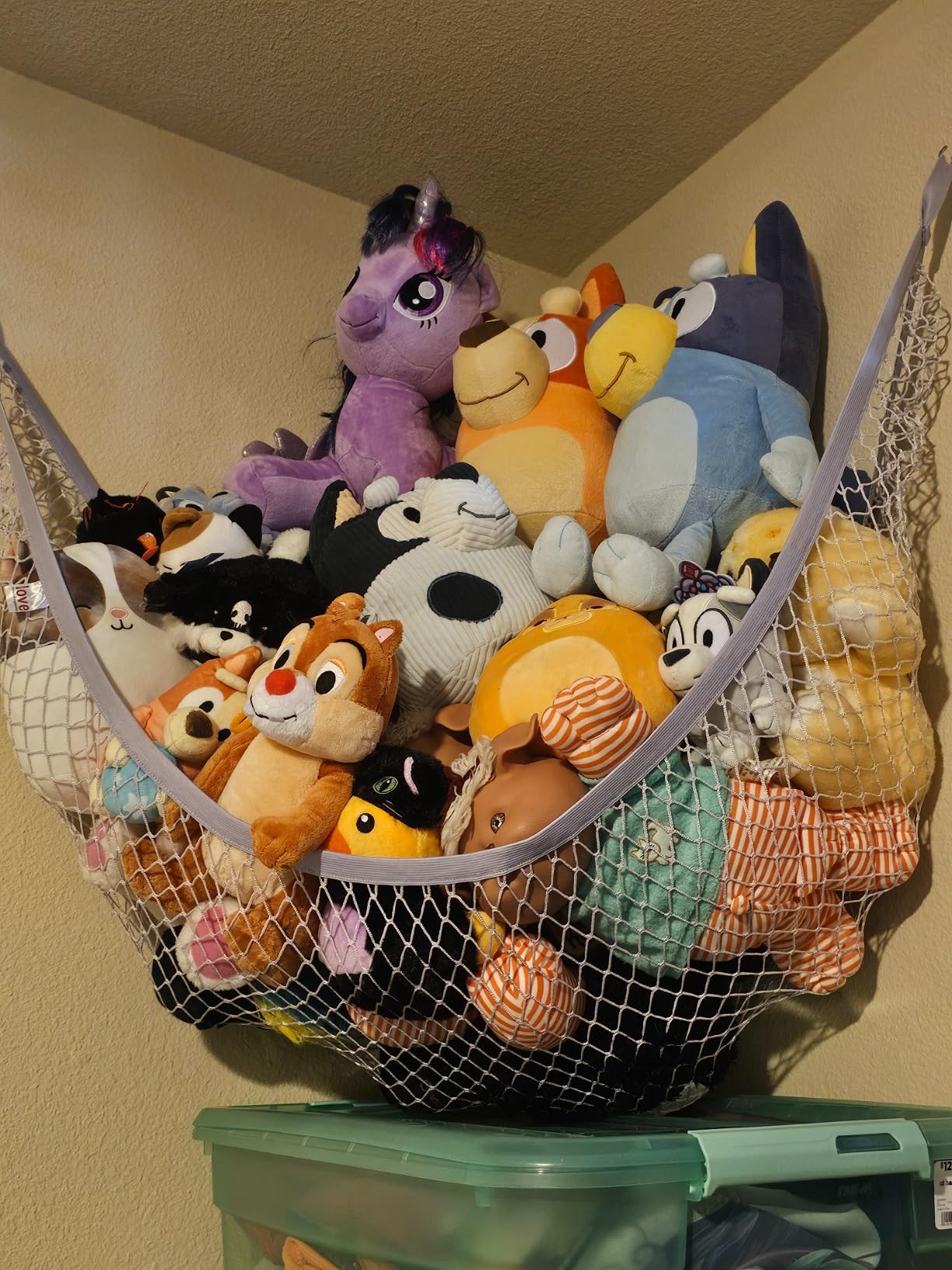
Shop this: Lilly’s Love Stuffed Animal Hammock on Amazon
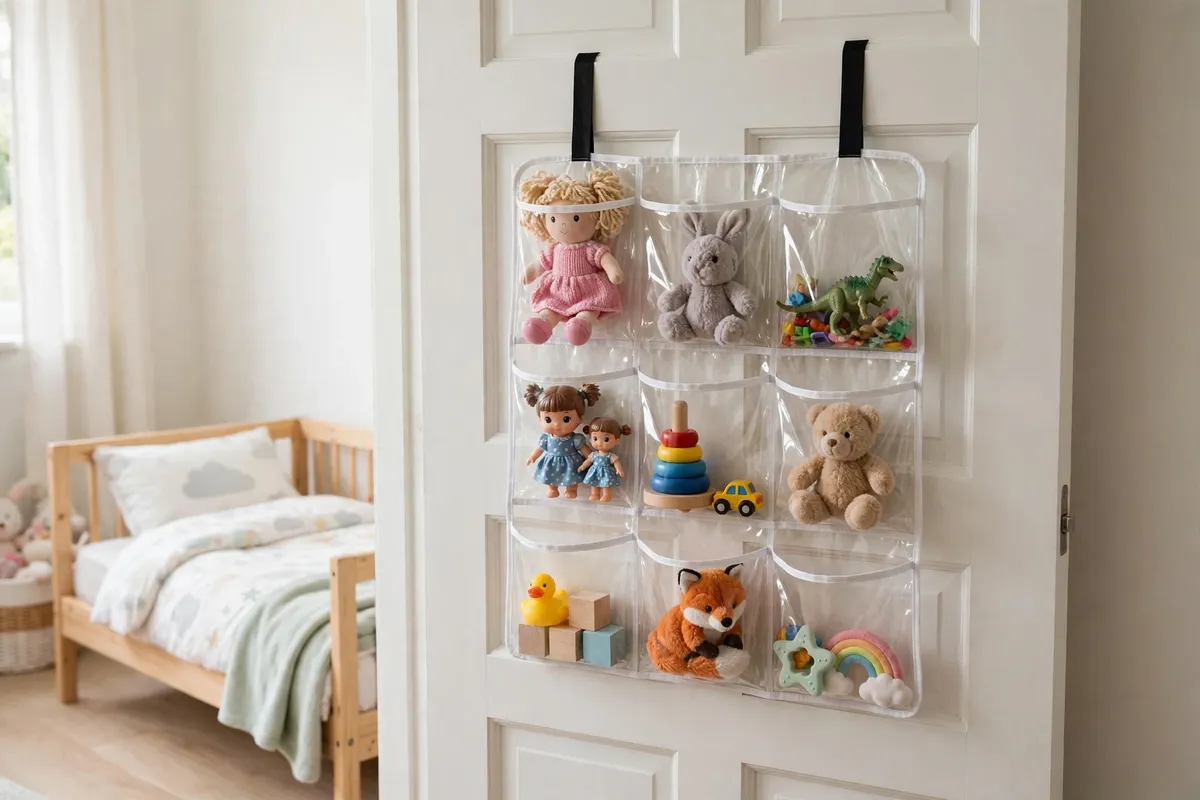
14. Hang an over-door organiser for the small toys
The back of the bedroom door is a full cabinet nobody uses. A clear-pocket over-door organiser — about 15 in wide and 55–58 in tall — holds dolls, small figures, hair accessories, craft supplies and the toys too small for a bin, each one visible through its pocket, with no wall damage and no floor space at all.
Try this: keep the pockets the child can reach for the toys they play with daily, and the top pockets for the things that need an adult. If the organiser stops the door closing flat, it is too full.
Cost: under $25 · Time: 5 minutes · Renter-safe: yes, over the door.
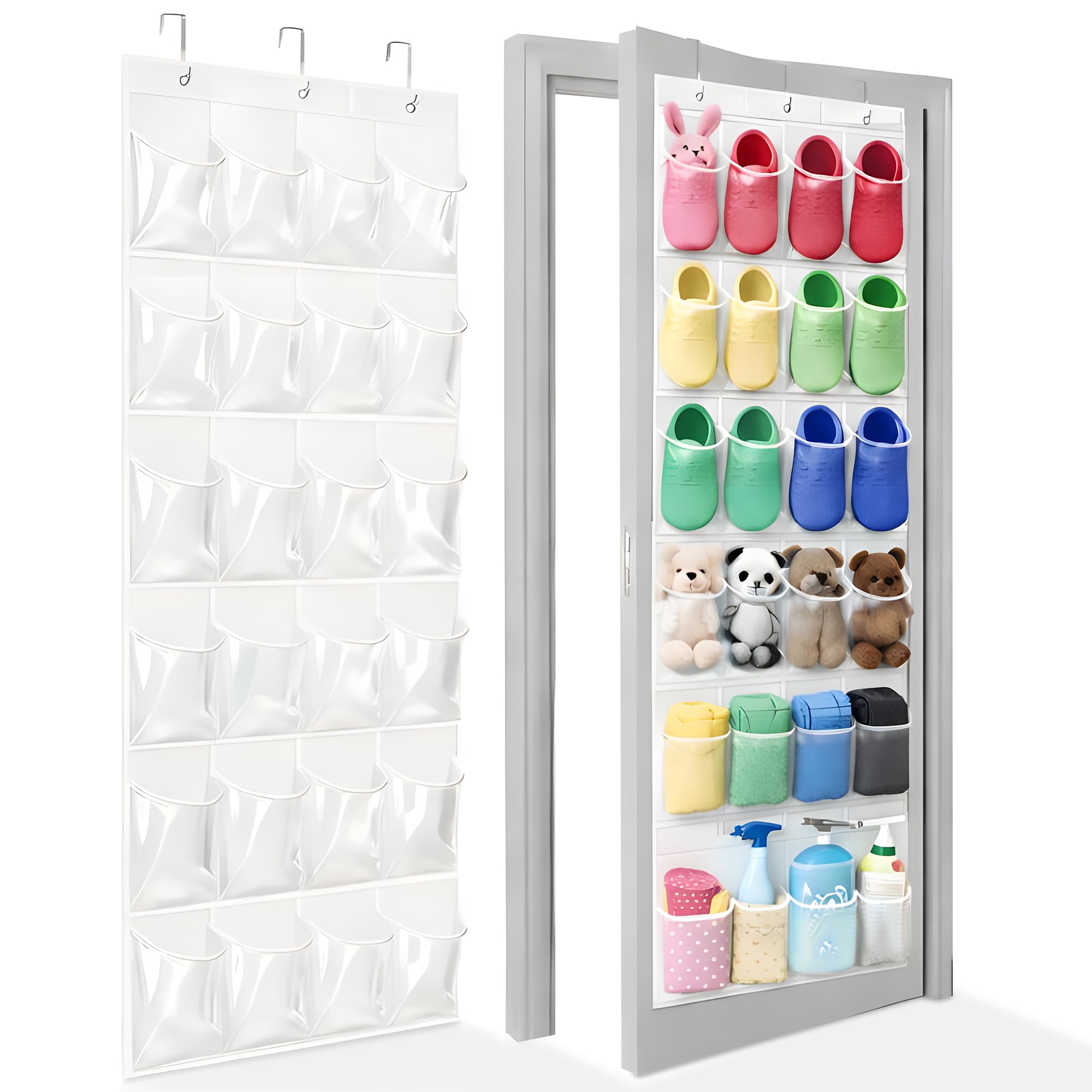
Shop this: Bofoho Over The Door Shoe Organizer on Amazon
What to do first: 3 kids room storage ideas to start with
Start with these three kids room storage ideas first: ideas 1, 2 and 6 — audit the toys and cut a third, put out one balanced set of 6–10, and label every bin with a picture. Together they cost about $0, take under an hour, need no drilling, and fix the three things that make a small kids’ room unusable: too many toys out, no visible choice, and no cleanup a child can do alone. Then add the TROFAST (idea 4) once the sort is done, and the under-bed rolling bins (idea 7) for the resting sets. These small kids bedroom storage ideas work because they start with fewer toys out, not with more furniture.
More ideas for small spaces: 14 Small Closet Organization Ideas for Apartments Under 500 Sq Ft and 12 Under-Bed Storage Ideas for Small Bedrooms.
